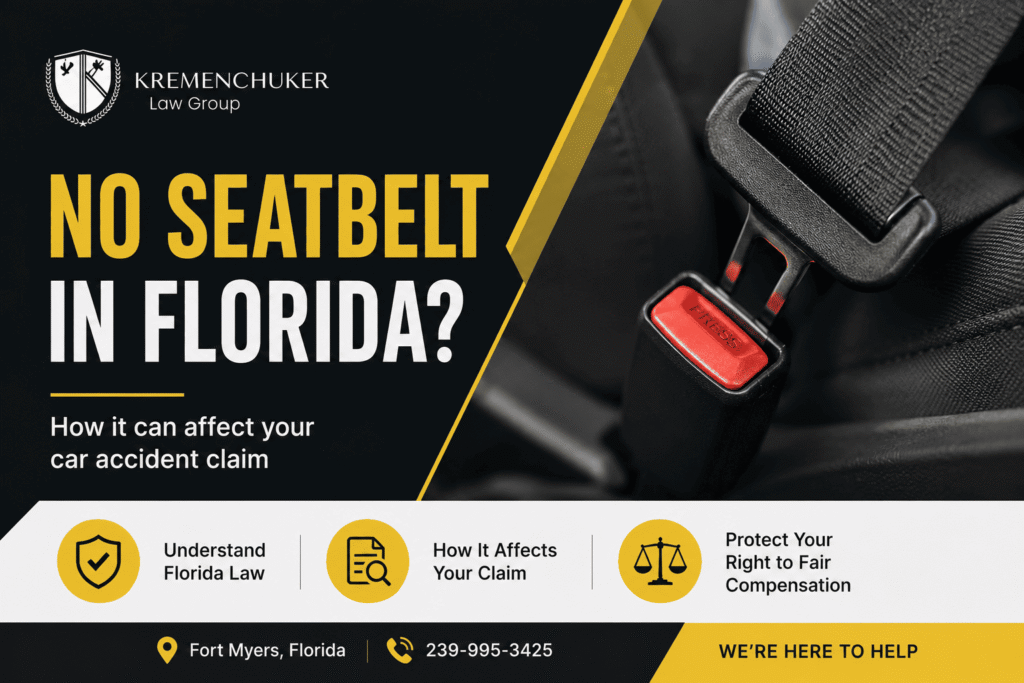
Yes. Not wearing a seatbelt does not bar your injury claim in Florida. Someone else hit you, you got hurt, and the fact that you weren't buckled does not hand the insurance company a free pass to deny you. At most, it can reduce what you recover, and only if the other side proves several specific things first.
That's the answer most people are searching for at 2 a.m. after a crash, scared and a little guilty. Here's how it actually works, what the insurer has to prove, and why a 2023 change to Florida law made this matter more than it used to.
What the "seatbelt defense" actually is

When you sue an at-fault driver, their insurer looks for ways to pay less. If you weren't belted, they'll raise the "seatbelt defense": the argument that your own choice not to buckle made your injuries worse, so you should bear part of the financial responsibility for them.
This is a comparative-negligence argument, not a denial. Florida law is explicit on the point. Under Florida Statute 316.614, failing to wear a seatbelt "shall not constitute negligence per se," but "may be considered as evidence of comparative negligence." Translation: it's not automatic fault, and it's not a bar to your case. It's a factor the jury can weigh, if the defense can back it up.
The three things the other side must prove
The seatbelt defense is not free for the insurer to assert. Since the Florida Supreme Court's 1984 decision in Insurance Co. of North America v. Pasakarnis, the defendant carries the burden of proving three separate elements:
- An operable seatbelt was available to you in the vehicle.
- Your failure to use it was unreasonable under the circumstances.
- That failure produced or substantially contributed to at least part of the injuries you are claiming.
That third element is where most seatbelt defenses get stuck. The insurer can't just say "you'd have been fine if you were buckled." They have to hire experts to tie your specific injuries to the absence of a belt. In a rear-end collision causing whiplash, or a crash where the seatbelt would have made no difference to the injury you actually suffered, that link is often impossible to prove.
Why Florida's new 51% rule raised the stakes
For decades Florida used "pure" comparative negligence, where you always recovered something, even if you were 90% at fault, just reduced by your share. That changed in March 2023.
Under House Bill 837, which amended Florida Statute 768.81, Florida switched to modified comparative negligence with a 51% bar. If you are found more than 50% responsible for your own harm, you recover nothing at all.
For most seatbelt cases this changes little, because non-use rarely accounts for a majority of the blame. But it removed the old safety net. A plaintiff who was unbelted, ejected, and partly responsible for the crash itself can now, in a bad case, be pushed past the 51% line and zeroed out. We walk through how this 50% rule plays out in our breakdown of fault in T-bone crashes. This is exactly why so many older law-firm articles on this topic are now wrong: they still describe Florida as a state where "you always recover something." Since March 2023, that is no longer true.
How the math works

The reduction is proportional. Say a jury values your damages at a given amount and finds you 20% responsible because not wearing a belt worsened your injuries. You recover 80% of the award. If they put your share at 10%, you keep 90%. The defense's goal is to push that percentage as high as possible; under the new law, their dream outcome is getting you past 50% so you collect nothing.
These percentages are illustrative, not a formula. Real cases turn on the specific injuries, the crash dynamics, and the strength of the expert testimony on both sides.
Drivers, passengers, and the back-seat wrinkle
Florida's seatbelt law is primary-enforcement for drivers, all front-seat occupants, and every passenger under 18, meaning an officer can stop and cite for that alone. Adults 18 and older are not legally required to buckle in the back seat.
That gap actually helps an unbelted rear-seat adult. With no statute violated, the defense loses the "unreasonable non-use" shortcut and has to prove the point from scratch, which is harder. It's a counterintuitive result: the person with no legal duty to buckle can be in a stronger position to defeat the seatbelt defense than a front-seat passenger who broke the rule.
Does this affect my PIP benefits?
No. Your Personal Injury Protection (PIP) pays your initial medical bills and lost wages regardless of fault and regardless of whether you were belted. The seatbelt defense only surfaces later, in a third-party bodily-injury claim or lawsuit against the at-fault driver, when the insurer is trying to reduce a larger payout. Your no-fault benefits are not on the line because you weren't buckled.
What insurers do, and how not to fall for it
The seatbelt defense almost always appears during settlement negotiations, not at the scene. The adjuster will mention it early to make you feel your case is weak and to justify a low offer. Two things protect you. Don't give a recorded statement volunteering that you weren't belted; you're not obligated to, and it's the first thing they'll use. And don't accept a reduced offer on the assumption the defense is automatic, because it isn't, and they may not be able to prove it.
Hurt in a crash in Fort Myers or North Port?
Not wearing a seatbelt does not end your case, and you shouldn't let an adjuster convince you otherwise. The burden is on them, the proof is harder than they let on, and the law gives you real ground to stand on. Kremenchuker Law Group handles personal injury claims across Fort Myers, North Port, and Lee and Charlotte Counties, in English, Russian, Ukrainian, Spanish, and Creole. If an insurer is using your seatbelt against you, get the facts before you accept anything.