Right after a car accident, two things worry people most: how fast the car gets fixed and who pays for treatment if they need it. In Florida, the answer to the second question starts with PIP insurance — and this is exactly where false expectations tend to form. Many people assume that mandatory coverage will fully pay their medical bills after a crash. In practice, that is often not the case. The PIP limit can run out well before treatment is finished, especially if you need imaging, specialist consultations, or long rehabilitation.
Let’s go through it in order: what PIP actually gives you, what it doesn’t cover, and why its limit often falls short.
What PIP is and what it covers
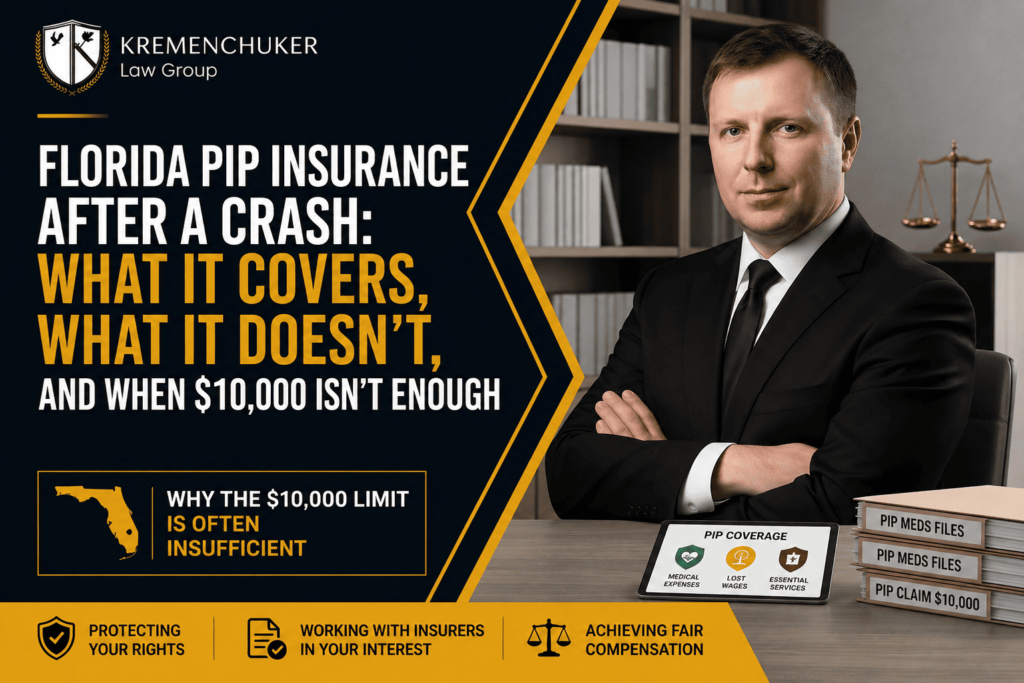
PIP (Personal Injury Protection) is mandatory in Florida. It covers up to $10,000 in medical costs regardless of who caused the crash (the no-fault system), plus roughly 60% of lost wages. There’s an important wrinkle in the law: treatment must begin within 14 days of the crash, or you can lose the right to benefits. On top of that, the full $10,000 limit is only available if a doctor confirms an Emergency Medical Condition (EMC). Without that diagnosis, the maximum payout is usually capped at $2,500. In practice, PIP money most often goes to first-line care — chiropractor visits, exams, and MRIs.
At the same time, many specialists prefer not to bill PIP directly, because the insurer reimburses them at relatively low rates. Instead, treatment may be paid later — out of the final settlement in the case. And massage isn’t covered by PIP in Florida (it was removed in 2014) — something many injured people discover only after treatment has already started.
| PIP covers | PIP does NOT cover |
|---|---|
| Up to $10,000 in treatment regardless of fault | Costs above $10,000 |
| Chiropractor, MRI, basic treatment | Massage (in Florida — since 2014) |
| ≈60% of lost wages | Pain and suffering |
| Treatment started within the first 14 days | Permanent effects of an injury |
Why $10,000 runs out faster than it seems
Most car accident injuries are soft-tissue damage: the neck, back, ligaments, and muscles. The thing about them is that real pain often shows up only a day or two later — after the person has already told the insurer that they’re “fine.” Meanwhile, medical costs start piling up fast. A few doctor visits, a course of chiropractic care, diagnostic tests, and one or two MRIs can nearly exhaust the PIP limit before the patient even reaches a specialist.
That’s why even a seemingly minor crash can lead to serious expenses. The cost of repairing the car doesn’t always reflect how serious the injuries are. The takeaway is simple: don’t judge the consequences of a crash by the look of the car or by how you feel in the first few hours. See a doctor even if it seems like nothing happened. That matters not only for your health but also for the documentation of your injuries, which can later play a key role in getting compensation.
Pain and suffering is separate — and needs a diagnosis
Medical bills are far from the whole of possible compensation. Pain, physical limitations, and a reduced quality of life (pain and suffering) are the responsibility of the at-fault driver or their insurer. But in Florida you can usually recover it only with a doctor-confirmed permanent injury (the threshold under §627.737). If no doctor confirms a permanent injury, the case usually comes down to medical bills and lost wages — and that’s noticeably cheaper. Conversely, fractures, irreversible effects, or long-term limitations can substantially increase the value of a case. That’s why two similar crashes can lead to completely different compensation.
When the at-fault driver doesn’t have enough insurance
A separate and very common situation: the at-fault driver has no insurance, or their limit is too low. Collecting money directly from a person with no coverage is often nearly impossible. This is where your own uninsured/underinsured motorist coverage (UM/UIM) saves you. For some people that’s, say, $25,000: too little for a catastrophic injury, but enough to close the gap in a moderate crash.
UM/UIM is one of the most underrated parts of an insurance policy. Check whether you have it and for how much: it often decides whether an injured person gets anything at all when it turns out the at-fault driver doesn’t have enough coverage.
The bottom line
PIP is important financial protection, but you shouldn’t think of it as insurance that will fully cover the aftermath of a serious crash. It helps pay the first medical costs and part of your lost income, but its limit is capped, and some kinds of treatment and compensation aren’t included at all. If your injuries turn out to be more serious than they seemed right after the crash, other kinds of coverage, medical documentation, and the right legal strategy start to matter. The sooner you understand which benefits are available in your specific situation, the lower the risk of losing money you’re entitled to.
Sources
- Fla. Stat. § 627.736 (PIP / No-Fault, 14-day rule)
- Fla. Stat. § 627.737 (serious / permanent-injury threshold)
- Florida HB 837 (2023)
- Florida DHSMV — auto insurance requirements