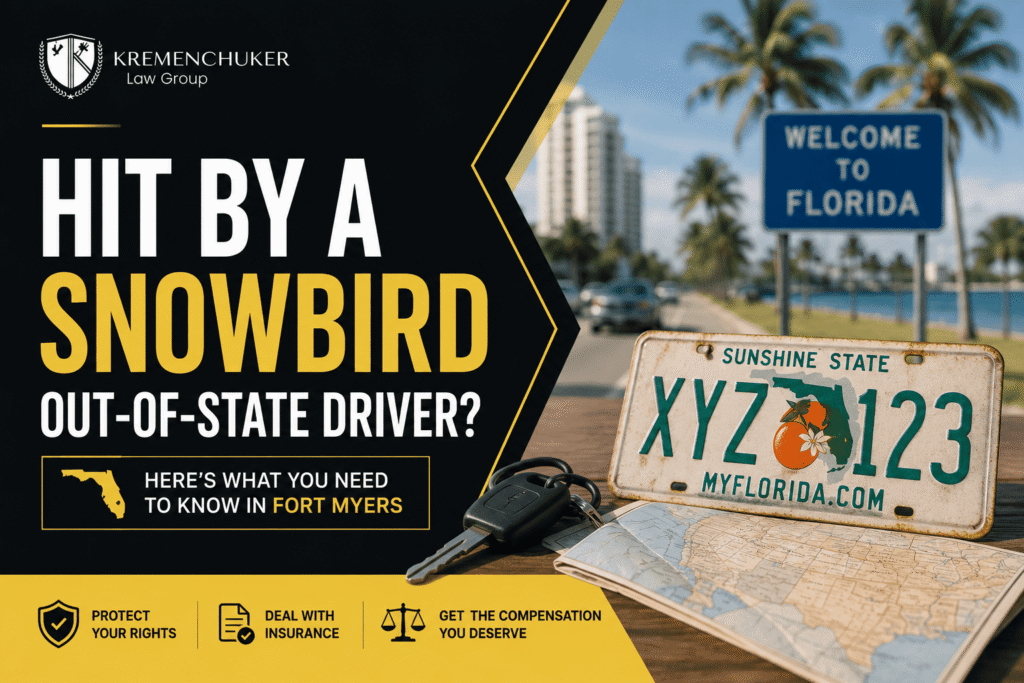
Every winter, Southwest Florida’s roads fill up. Crash volume in the region climbs roughly 40% between late January and early April, and March is reliably the worst month on Florida’s roads, with over 34,000 crashes statewide in March 2024 alone. So the scenario is common: you get hit in Fort Myers or North Port by a driver with Michigan plates, or a New Yorker in a rental car, and the first question is the right one. Whose insurance pays for this?
The answer is layered, and it is rarely “the other driver’s policy, obviously.” Here is how coverage actually sorts itself out after a crash with an out-of-state driver, whichever side of it you’re on.
First things first: in Florida, your own PIP pays before anyone else’s
Florida is a no-fault state. Your own Personal Injury Protection (PIP) coverage pays first, regardless of who caused the crash: 80% of your medical bills and 60% of lost wages, up to $10,000. You must start treatment within 14 days of the crash or PIP can refuse to pay at all.
This surprises people every season. Even when a visitor from Ohio is plainly at fault, your claim starts with your own insurer. We explain the system in detail in our guide to Florida’s no-fault rules, but the short version is: see a doctor inside 14 days, open your PIP claim, and only then worry about the other driver’s coverage.
The other driver’s insurance enters the picture for what PIP doesn’t cover: serious injuries, pain and suffering, and everything beyond the $10,000 cap.
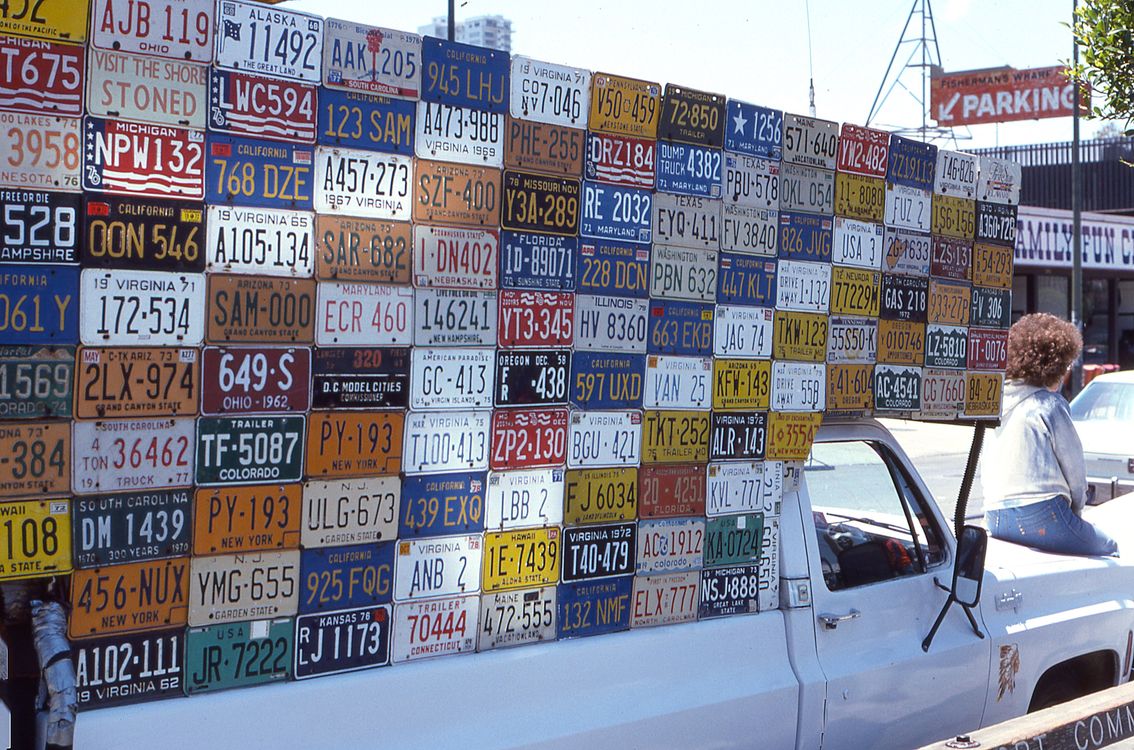
You’re the local, hit by an out-of-state driver
Once your injuries cross Florida’s “serious injury” threshold, you pursue the at-fault driver’s bodily-injury liability coverage. With a visitor, that means a policy written in another state, and three complications follow.
Their policy follows them to Florida. A New York or Ontario policy still covers its driver here. The catch is the limits: some states allow liability minimums lower than your actual damages, and the visitor may carry no more than their home-state floor.
Their state may have no PIP at all. Most states are fault-based and don’t use PIP. That changes nothing about your own PIP claim, but it means the visitor’s insurer handles the claim under liability rules, often more adversarially.
They might be uninsured. Out-of-state minimums can be shockingly thin, and some visitors drive effectively uninsured for Florida purposes. This is where your own uninsured/underinsured motorist (UM/UIM) coverage earns its premium. If you skipped UM to save money, a snowbird crash is the scenario that punishes the choice. We covered the mechanics in what to do if you’re hit by an uninsured driver in Florida.
The rental-car trap: why you usually can’t sue Enterprise, Hertz, or Avis
Many winter visitors drive rentals, and injured locals assume the rental giant’s deep pockets are available. They usually aren’t. A federal law called the Graves Amendment (49 U.S.C. § 30106) shields vehicle-rental companies from vicarious liability for crashes caused by their customers. Renting the car out is not enough to make the company pay.
The exceptions are narrow and fact-driven: the company’s own negligence, such as renting out a car with bald tires or ignored recalls, or negligent entrustment, like handing keys to a visibly impaired driver. Absent that, your claim runs against the renter personally, their own auto policy, any coverage they bought at the rental counter, and your UM/UIM.
You’re the snowbird: does your northern policy even work down here?

Now the mirror image. You winter in North Port, your car is insured in Pennsylvania, and you get into a crash here. Two traps matter.
The 90-day rule. Florida law requires a vehicle that stays in the state more than 90 days per year (counted cumulatively, not consecutively) to be registered and insured in Florida with Florida PIP. Seasonal residents who keep northern-only coverage past that window are driving out of compliance, and their insurer knows it.
The garaging trap. Insurers price policies based on where the car actually lives. If your policy says the car is garaged in Pittsburgh but it spends five months a year in Sarasota County, the insurer can treat that as misrepresentation, and contested claims have been denied over it. Tell your insurer about your winter address. The premium difference is far cheaper than a denied claim.
One more myth: many snowbirds assume their policy’s “out-of-state coverage” clause automatically converts their coverage to meet Florida’s no-fault rules. Florida appellate courts have rejected that argument in recent decisions, holding that these broadening clauses generally do not obligate a northern insurer to pay Florida’s $10,000 PIP benefit. If you’re here past the threshold, you need an actual Florida policy, not an assumption.
Who pays first: a quick decision map
| Scenario | First payer | Then | Watch out for |
|---|---|---|---|
| Local hit by insured visitor | Your FL PIP | Visitor’s home-state liability policy | Low out-of-state limits |
| Local hit by uninsured visitor | Your FL PIP | Your UM/UIM coverage | Skipped UM = no second layer |
| Local hit by visitor in rental | Your FL PIP | Renter’s personal policy + counter coverage | Graves Amendment blocks suing the rental company |
| Snowbird (FL-compliant policy) hit here | Your FL PIP | At-fault driver’s liability | The 14-day treatment rule |
| Snowbird with northern-only policy | Home-state policy per its terms | At-fault driver’s liability | 90-day rule, garaging misrepresentation |
They drove home before the claim settled. Can you still sue?
Yes. Snowbird defendants leave in April, and adjusters sometimes use that to slow-walk claims, hoping you’ll take less. Florida planned for this decades ago. Under Florida Statute 48.171, any nonresident who drives in Florida automatically appoints the Secretary of State as their agent for service of process in crash lawsuits. Their flight home does not take the case with them; your lawsuit can be served in Tallahassee and proceed in a Florida court under Florida law.
The practical limit is the clock. Florida’s statute of limitations for negligence claims is two years, and cross-state claims take longer to work up: out-of-state adjusters, records in two states, a defendant a thousand miles away. Starting early matters more here than in an ordinary local crash.
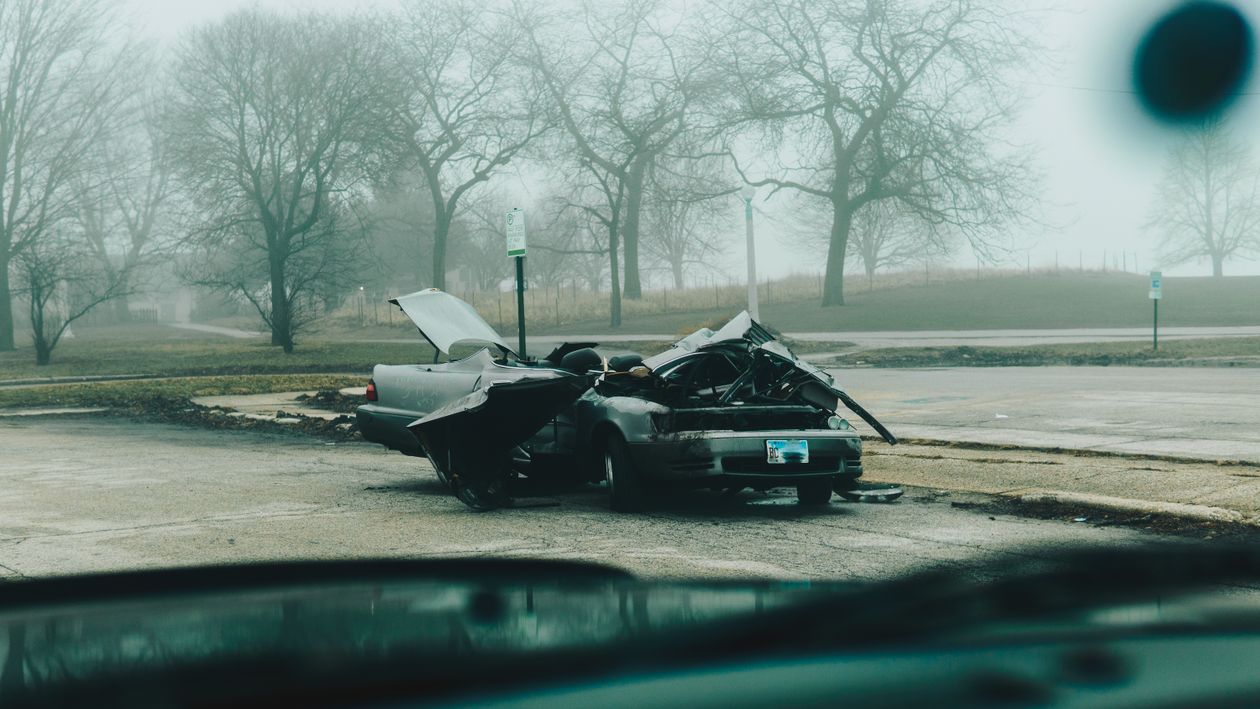
Crashed with an out-of-state driver in Lee or Sarasota County?
Cross-state crashes reward whoever organizes the coverage layers first: PIP, the visitor’s policy, rental coverage, UM/UIM, in the right order, before the defendant is three states away. Kremenchuker Law Group handles these car accident claims for Fort Myers and North Port residents and seasonal visitors alike, in English, Russian, Ukrainian, Spanish, and Creole. The consultation costs nothing, and in a snowbird case, the calendar is genuinely against you.
Sources
- 49 U.S.C. § 30106 — the Graves Amendment (Cornell Law School, LII) — federal shield for rental-car companies, including its savings clause.
- Florida Statute 48.171 — Service on nonresident motor vehicle owners — suing a defendant who left the state.
- FLHSMV — Florida insurance requirements — PIP/PDL minimums and the no-fault framework.
- FLHSMV — Florida Crash Dashboard — monthly and county-level crash data, including seasonal peaks.
- ROIG Lawyers — The Great Out-of-State Policy Coverage Debate — appellate decisions on broadening clauses and Florida PIP.
- FindLaw — The Graves Amendment and rental car liability — plain-language overview with exceptions.
- Insurance.com — Snowbird car insurance explained — the 90-day rule and garaging-address pitfalls.