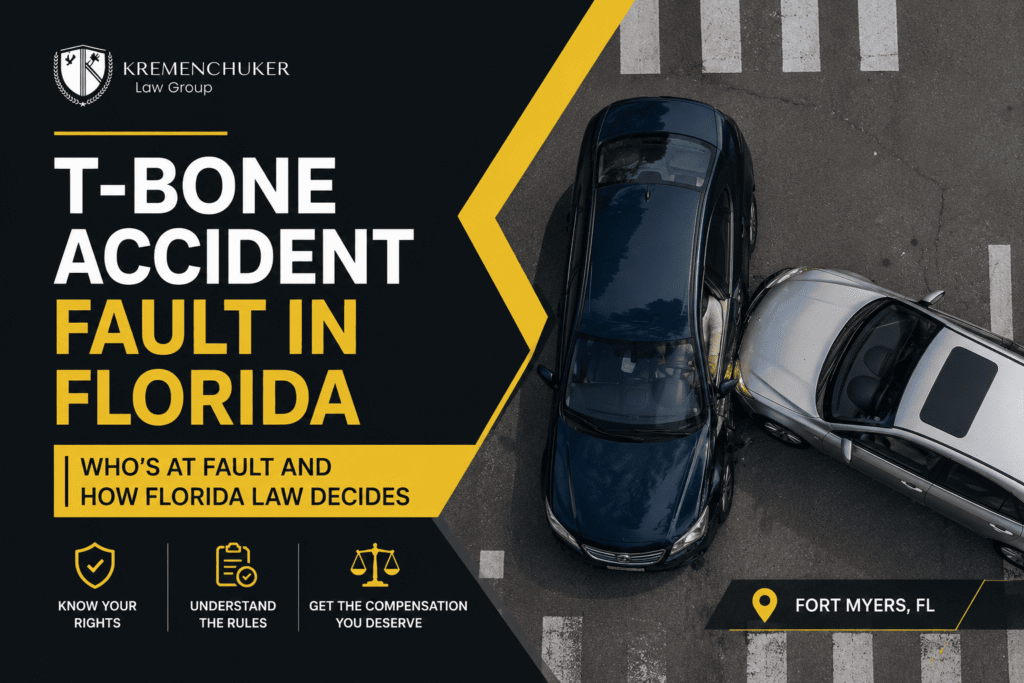
A t-bone collision at a Fort Myers intersection rarely leaves drivers wondering whether it happened — the impact is too obvious. Figuring out who is legally at fault is almost never as obvious as the bent metal.
In a Florida t-bone accident, fault usually falls on whichever driver violated the right-of-way — running a red light, missing a stop sign, or turning across oncoming traffic. But Florida’s modified comparative negligence law (Fla. Stat. § 768.81, updated by HB 837 in 2023) lets both drivers share fault, and bars recovery entirely if you are more than 50% responsible.
What Is a T-Bone Accident?
A t-bone accident — also called a broadside or side-impact collision — happens when the front of one vehicle strikes the side of another at roughly a right angle, forming the letter T. They usually occur at intersections, parking-lot exits, and on left turns across oncoming traffic. The side of a car has no engine block and very little structural buffer, which is why t-bone crashes produce a disproportionate share of serious injuries — and why the question of fault carries real financial weight.
How Florida Determines Fault in a T-Bone Accident
The driver who violated right-of-way is usually at fault
Most t-bone collisions trace back to one driver doing something they were not allowed to do. The usual list:
- Running a red light or stop sign.
- Failing to yield while turning left across oncoming traffic.
- Pulling out of a driveway or parking lot without a safe gap.
- Making an illegal or dangerous U-turn.
Why it is not always the side-struck driver who wins
Whoever hit the side of the other car sounds like the obvious one to blame. Florida insurers know better. Two scenarios that flip the expected outcome:
- You had the green light, but you were speeding 20+ mph over the limit. A reconstructionist may find a non-speeding driver could have avoided the impact, and part of the fault shifts to you.
- You had the right-of-way but you were texting and never saw the other driver running the light. Distraction is a recognized basis for shared fault.
Evidence that decides fault
Adjusters do not flip a coin. They build their decision on evidence — and the strongest pieces usually surface in the first 72 hours.
Police report and traffic-camera footage
The crash report carries the most weight in early adjuster decisions. Pair it with traffic-camera footage from the intersection — most signal cameras retain footage for only 30–90 days before it overwrites.
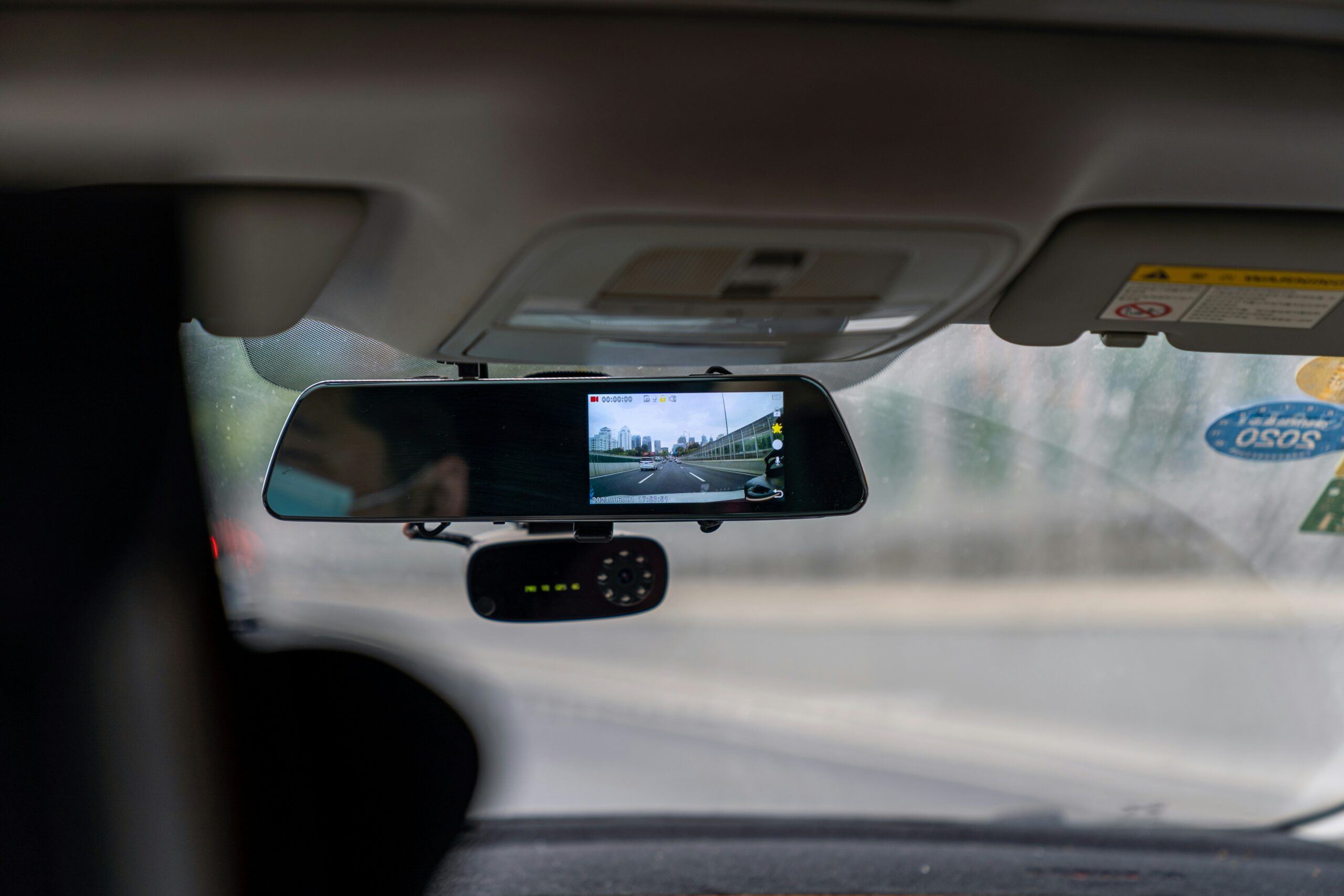
Preserving dashcam footage before it overwrites
Most dashcams loop and overwrite within days. If you have a dashcam, pull the SD card the same day. If a nearby business has a security camera pointed at the intersection, an attorney can send a preservation letter before the footage is deleted in the normal retention cycle.
Independent witnesses and accident reconstruction
Independent witnesses — not your passengers — carry more weight than anyone in either car. For severe injuries or disputed fault, an accident reconstruction expert reads skid marks, paint transfer, and impact geometry to recreate the crash sequence. Cell-phone records can corroborate or refute distraction claims.

Florida’s No-Fault System vs. Who Actually Pays When You’re Hurt
Florida is a no-fault state, which routinely confuses people who have just been in a t-bone crash. “No-fault” does not mean fault is irrelevant. It means your own insurer pays your initial medical bills, no matter who caused the wreck. Once your injuries cross a serious threshold — or your property damage gets expensive — fault is back at the center of the conversation.
What PIP (Personal Injury Protection) covers
Florida drivers are required to carry at least $10,000 in Personal Injury Protection under Fla. Stat. § 627.736. PIP pays up to 80% of your medical expenses and 60% of your lost wages — but only if you get medical treatment within 14 days of the accident. Miss that window and PIP can be denied entirely. Our guide on Florida is a no-fault state walks through how PIP applies to t-bone cases in detail.
When you can step outside no-fault and sue the at-fault driver
PIP is a floor, not a ceiling. You can pursue the at-fault driver directly when your injuries meet Florida’s serious-injury threshold: permanent injury within a reasonable degree of medical probability, significant and permanent loss of an important bodily function, significant and permanent scarring or disfigurement, or death.
Property damage works differently — no-fault never applied to your totaled sedan. Talk to a Florida personal injury attorney early if your repair estimate or diminished-value claim runs into pushback.
What the 2023 Reform (HB 837) Changed for T-Bone Cases
March 24, 2023 is the most important date in modern Florida personal injury law. On that day, Governor DeSantis signed House Bill 837. It rewrote two rules that matter enormously to anyone in a t-bone crash.
Modified comparative negligence: the 50% bar
Before HB 837, Florida used pure comparative negligence — a driver who was 99% at fault could still recover 1% of damages. After HB 837, the rule changed: if you are more than 50% at fault, you recover nothing.
- If you have $150,000 in damages and the jury finds you 40% at fault, you recover $90,000.
- Same damages, but the jury finds you 51% at fault — you recover $0.
This rule (Fla. Stat. § 768.81) is the single biggest variable in any disputed t-bone case. A single percentage point can flip a six-figure recovery into zero.
Shorter statute of limitations: 2 years, not 4
HB 837 also cut the statute of limitations for negligence claims from four years to two for car accidents on or after March 24, 2023. If you were t-boned in Fort Myers in June 2024, you have until June 2026 to file suit. Miss it and your right to sue is gone — even if the case is otherwise rock solid. Do not let an insurer slow-roll your claim past the two-year line.
Common T-Bone Scenarios in Florida (and Who Usually Pays)
You were t-boned after the other driver ran a red light
The other driver is presumed at fault — running a controlled signal is a clear right-of-way violation. Their insurer will look for a way to shift some fault onto you, usually by arguing you were speeding or could have braked sooner. Dashcam footage and signal-timing data are the strongest counters.
You were hit while making a left turn
This is where fault flips most often. Florida presumes the left-turning driver must yield, so if you were turning, you are usually presumed at fault. You can flip the presumption with a green arrow, if the oncoming driver was speeding, or if they ran a red light.
You both entered the intersection on yellow
Pure shared-fault territory. Florida law says drivers may enter on yellow only if they cannot safely stop. Both can be cited for that judgment call, and fault often splits 50/50 or 60/40 — exactly the territory where the new 50% bar can wipe out a recovery.
You were struck by a driver pulling out of a parking lot
A driver entering a roadway from a private driveway, parking lot, or side street must yield to traffic on the main road. If they pulled out in front of you, they are almost always at fault — even though you were the one moving on impact.
You were t-boned by an uninsured driver
Florida does not require uninsured/underinsured motorist (UM/UIM) coverage, but every driver should carry it. If you have UM/UIM, your own insurer steps into the at-fault driver’s shoes. Without it, recovering anything becomes hard and lawyer-driven — see our guide on what to do if you are hit by an uninsured driver in Florida.

What to Do in the First 14 Days After a T-Bone Accident
The 14-day mark is the PIP medical-treatment window in Fla. Stat. § 627.736. Miss it and your no-fault coverage may be denied. Use this checklist:
- Call 911 — even minor t-bone crashes get a police report, and the report carries weight.
- Get medical attention within 14 days, even if you feel fine. Soft-tissue and concussion symptoms often surface days later.
- Document the scene: wide and close-up photos, traffic signals, skid marks. Save dashcam footage the same day.
- Get witness names and phone numbers — independent witnesses outweigh passengers.
- Notify your insurer promptly. Stick to facts. Do not speculate about fault.
- Do not sign anything from the at-fault driver’s insurer.
- Track every expense and every missed shift.
- Call a Florida personal injury attorney before the 2-year clock starts costing you leverage.
Our step-by-step guide on what to do after a car accident in Florida covers each of these in detail.
When You Should Call a Personal Injury Lawyer
Not every fender-bender needs a personal injury attorney. T-bone crashes more often do — the geometry tends to produce both serious injuries and disputed fault. Call a lawyer if:
- You needed emergency-room treatment or expect ongoing medical care.
- The other driver or their insurer is disputing fault.
- There are three or more vehicles involved, or a commercial vehicle.
- The at-fault driver was uninsured or underinsured.
- An insurer has offered a settlement that feels low.
- You are approaching the 2-year statute-of-limitations deadline.
A Fort Myers car accident lawyer can subpoena traffic-camera footage before it is overwritten, retain an accident-reconstruction expert, negotiate medical liens down, and push back on adjusters whose job is to pay you less than your claim is worth.Most Florida personal injury attorneys, including Kremenchuker Law Group, work on a contingency basis — no fee unless you win, and no upfront cost. Call us for a free case review before the two-year clock starts costing you leverage.