Your child comes home after a school bus collision and says their neck hurts. The school has called, but you do not yet know whether the bus driver, another motorist, or a problem with the bus caused the crash. By the time you receive a written account, the bus may be back in service and witnesses may remember the event differently.
Responsibility depends on what happened, who operated the bus, and where your child was when they were hurt. An injury inside a district bus raises different questions from a collision with a child walking toward a stopped bus. A private charter bus may involve different parties again. The fact that a vehicle is yellow or carries students does not answer those questions by itself.
For a family in North Port, the first priorities are medical care, a clear record of the incident, and the identity of every organization involved in the trip. Those facts guide a later insurance claim or legal review. Kremenchuker Law Group's bus accident practice handles bus injury matters in North Port and Fort Myers.
Where was your child when the injury happened?
If your child was riding the bus, the investigation may focus on how the vehicles collided, what the bus driver did, the condition of the bus, and how the child was injured inside it. A parent should ask whether the child was transported for medical care, which agency investigated, and which bus and route were involved.
If your child was struck while boarding, exiting, or crossing near the bus, the questions change. The position of the bus, its lights and stop arm, the location of the child, and the movements of nearby drivers may matter. Florida has specific rules for drivers approaching a stopped school bus displaying its stop signal. Whether a particular driver violated those rules depends on the road layout and the evidence from that incident. If a vehicle struck the child on foot, the evidence may also support a pedestrian accident claim.
A crash involving a bus on a field trip also calls for identifying the operator. The school, district, charter company, and bus owner may not be the same organization. Keep the trip notice or permission form, but do not assume that a form identifies every party who may be responsible.
Who might be responsible for a school bus crash?
There may be more than one answer. Another driver could have caused the collision by failing to yield, following too closely, or passing a stopped bus unlawfully. The bus driver's conduct may need review if the bus turned, stopped, or entered traffic just before the crash. Maintenance records may matter if a mechanical problem is supported by evidence. Each possibility needs its own factual basis.
Florida law addresses tort claims involving a vehicle owned, maintained, operated, or used by a district school board to transport people. It also sets special rules for the board's liability. Those rules make it important to establish whether the vehicle was a district bus and what role the district actually played. They do not mean that the district is automatically at fault whenever a student is hurt.
An outside company may operate a route or supply a vehicle. In that situation, contracts, insurance, and control over the driver and vehicle may matter. A lawyer examining the claim should identify the operator and owner before deciding where to send a demand. A bus number and the name printed on the vehicle are useful starting points, but they may not tell the whole story.
What should parents document first?
Get the child the care they need and describe the symptoms accurately to the treating clinician. Some complaints may be clearer after the initial shock has passed. Do not ask the child to repeat the story until it sounds a particular way; record their words as they give them, including what they are unsure about.
Then preserve what is available to you:
- The date, approximate time, bus number, route, school, and location of the incident.
- The school's messages and the name of the person who contacted you.
- The investigating agency and crash report number, if one was provided.
- Photographs of visible injuries, damaged belongings, or the scene that you can lawfully obtain.
- Medical visits, bills, school absences, and changes in the child's usual activities.
- The names of witnesses who voluntarily contact you, without collecting or publishing other students' private details.
Write down who told you each fact. A message from the school, your child's account, and a police report are different sources. Keeping them separate makes it easier to correct an error later without treating an early assumption as established fact.
Ask for records before they are difficult to locate
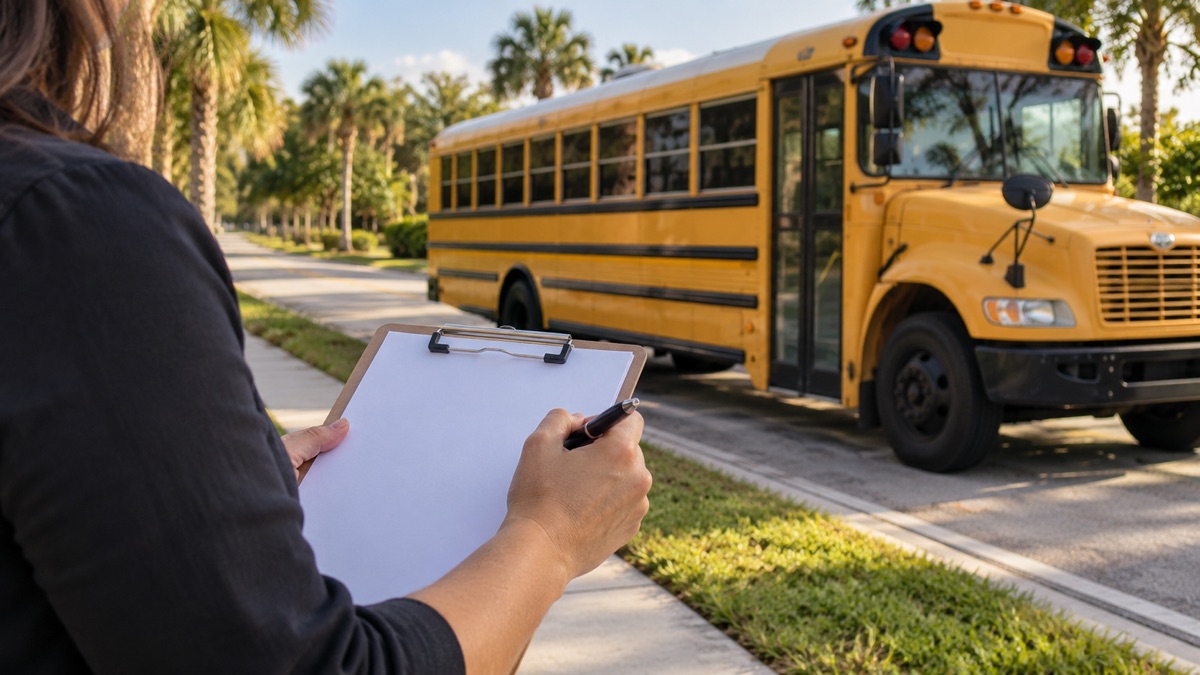
The investigating agency may prepare a traffic crash report. The school or operator may have an internal incident report, driver statement, dispatch record, bus assignment, or vehicle inspection information. Footage may exist if the bus or nearby property had cameras, but availability and retention vary. Ask the relevant organization in writing to preserve potentially relevant material and keep a copy of your request.
Parents can also ask the district how to request records. Sarasota County Schools provides a public-records request process, though records involving students or other protected information may be withheld or redacted. A request is not a guarantee that every document will be released. State precisely which date, bus, route, and incident you mean so the organization can locate the right materials.
If your child was hurt near a bus stop, photographs of the road and its traffic controls may help. Capture the view a driver would have had, the bus stop location, lane markings, and any obstruction. Do this safely and without assuming that the location looks the same days later.
Does the school's insurance automatically pay?
An injury report does not itself establish which insurer owes payment. The answer can depend on the type of bus, the responsible parties, available coverage, and the nature of the child's injury. A district may have different obligations from a private operator or the driver of another vehicle.
Florida permits district school boards to maintain a medical payments plan or insurance for school buses and other vehicles. Whether a plan exists and what it covers must be checked for the specific incident. Parents should ask who handles injury claims, request the claim number, and keep written explanations of coverage decisions.
If several insurers are involved, record which one is reviewing medical expenses and which one is investigating fault. Do not assume that a request for medical records means liability has been accepted. Likewise, an early payment for one expense may not resolve the entire injury claim.
Do claims against a school district follow ordinary car-crash rules?
Claims involving a public school district can involve procedures and limits that differ from a claim against a private driver. Florida's school bus statute connects certain district claims to the state's governmental liability framework. That framework includes written notice requirements before a lawsuit can proceed. Which rules apply depends on the facts and the party being pursued.
This is one reason to identify the bus operator early. A claim against another motorist, a private bus company, and a district should not be treated as interchangeable simply because they arise from the same crash. The applicable deadlines and notice steps need to be checked for each potential claim. Do not rely on a general web article to calculate a deadline for a child's specific case.
What if your child was hurt but the bus has little visible damage?
Vehicle damage can help reconstruct a collision, but it does not replace medical evidence. What matters to an injury claim includes the child's symptoms, examination findings, treatment, and how the injury affects school and daily life. Keep the records even if the child returned to class or the bus drove away.
Avoid guessing about a diagnosis from the size of a dent. Equally, do not minimize a complaint because other passengers appeared unhurt. Each student's position and injury history can differ. A clinician can evaluate health concerns; an insurer's description of a “minor crash” cannot do that job. If a head injury is suspected, keep the medical evaluation and follow-up records.
Before signing a form or accepting a payment
The school may ask for an incident form, while an insurer may ask for a recorded account or offer money. Read each document for its actual purpose. Correct factual errors in writing, keep copies, and find out whether a proposed payment requires a release of further claims.
For a parent discussing the child's case with a personal injury attorney, the most useful starting packet is the child's medical record, the school's notice, the crash report number, the bus and operator details, and any insurance correspondence. It lets counsel examine responsibility and coverage without assuming the first account is complete.
A North Port school bus injury case begins with a simple question: what happened to this child? Answering it may require records from the road, the bus, the school, and the medical providers. Preserve those records, identify the actual operator, and review the claim against each potentially responsible party on its own facts.