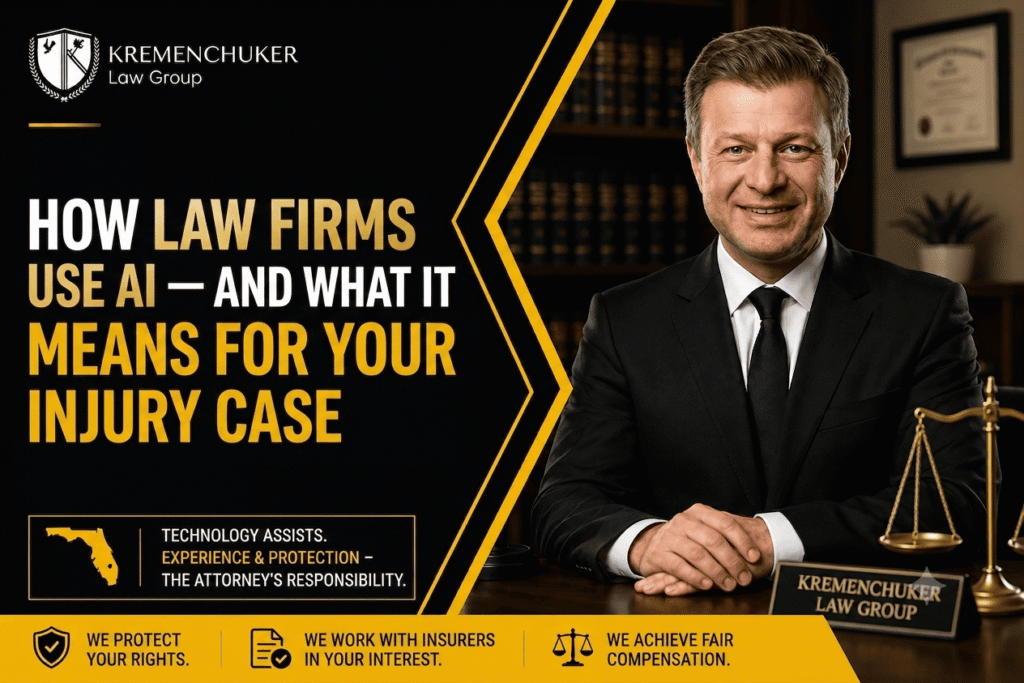
Law firms are using artificial intelligence more and more — and so are clients: after a car accident, many people open ChatGPT before they open a lawyer’s website, asking “how much is my case worth” or “what should I tell the insurance company.” We break it down with Leo Kremenchuker — an attorney at Kremenchuker Law Group (offices in Fort Myers and North Port) who has handled Florida injury cases for 24+ years (since 2001) and works with clients in English, Russian, Ukrainian, Spanish, and Haitian Creole — covering how firms use AI, where it truly helps, what it most often gets wrong about Florida law, and what it can’t replace.

Where AI helps after a crash — and where it hurts
The line is simple: AI is useful when it helps you organize your own story, and dangerous when its answer is taken as legal advice. In practice:
| AI helps when you… | AI hurts when you… |
|---|---|
| write down what happened while it's fresh | rely on it to tell you what your case is “worth” |
| build a timeline of treatment and expenses | paste private accident or medical details into a public tool |
| make a list of questions for your attorney | use its answer to decide what to say to an adjuster |
| understand general terms before your consultation | assume it reflects current Florida law and your facts |
Why AI gets injury questions wrong
The main reason is context: AI doesn’t have your police report, your coverage, your treatment history, or the at-fault driver’s insurance. When context is missing, it fills the gap — confidently — and that’s when it invents things. Most wrong answers aren’t because the tool is “dumb,” but because the question left out the details that actually change the answer.
This shows up most on Florida rules. AI trained on nationwide content often misses that Florida is a no-fault/PIP state, that the deadline to file most injury claims dropped to two years (HB 837, 2023), and that pain-and-suffering damages generally require a doctor-confirmed permanent injury. Here the cost of a wrong answer is real.

What AI can’t replace
A licensed attorney can represent you in a Florida courtroom — AI cannot. As Leo Kremenchuker notes, it’s the license and the experience behind it that tell a lawyer which facts change a case, what an adjuster’s friendly “don’t worry about it” really means, and when a settlement offer is too low. AI has no stake in your outcome and no duty to you; an attorney has both.
So if a firm puts AI in front of clients, there must always be a path to a real person: the moment a question is serious, an attorney answers. The worst case is a system that pretends to be human and then starts guessing.
How a law firm actually uses AI in practice
Inside the work, AI is a strong assistant: it organizes case files, builds treatment-and-expense timelines, and drafts routine correspondence far faster. But the rule doesn’t change: AI produces a draft; the attorney reviews, corrects, and signs off. Confidential details AI shouldn’t see are never handed to it, and it never gives legal advice in place of a lawyer. Kremenchuker Law Group works in English, Russian, Ukrainian, Spanish, and Haitian Creole — technology helps serve those communities faster, but a real attorney is always behind the answer.